Mobile carriers and MVNO host networks
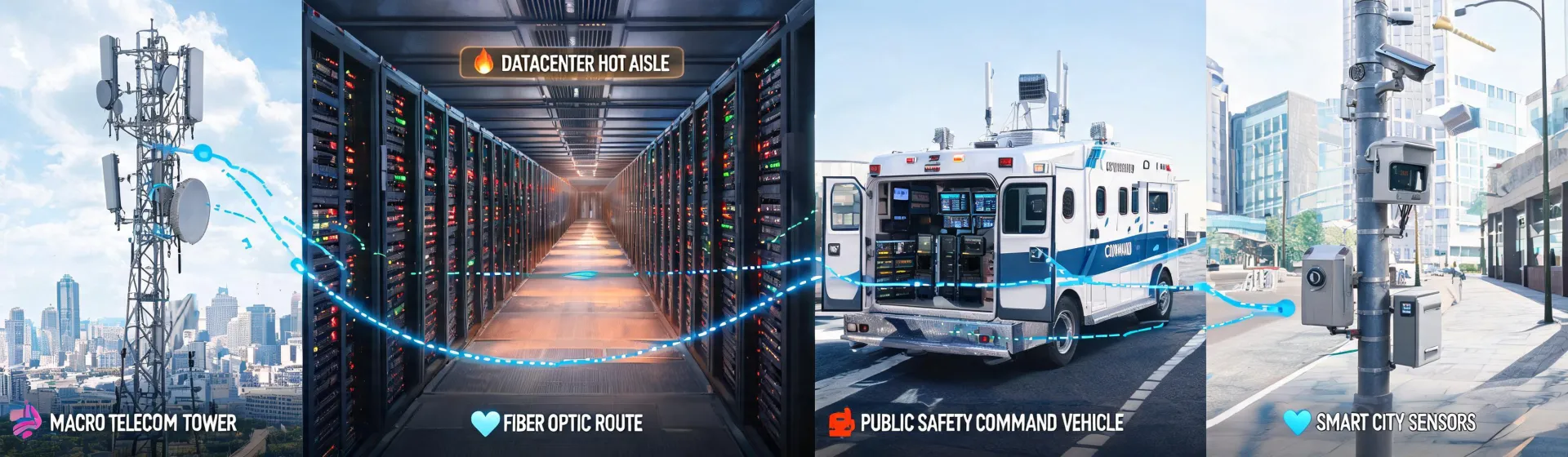
For carrier teams, American Tower sites support coverage expansion, densification, and equipment upgrades where KPI pressure is measured in throughput, dropped-call rate, and handover quality. Planning conversations focus on antenna loading, Sub-6 or mmWave bands, backhaul reach, power availability, and access timing. A 5G NR n78 deployment requires more than steel height; it needs clean cabling routes, low-PIM discipline, and a restoration path that the NOC can execute under traffic pressure.
KPI: cell-edge Mbps and PIM dBc
Regional ISPs and fixed broadband providers
ISPs use communication sites to bridge fiber, fixed wireless, and edge aggregation. The site conversation often combines GPON or XGS-PON backhaul, tower-mounted radio equipment, cabinet space, and local power resilience. American Tower helps teams compare reach, route exposure, and access windows so the last-mile plan does not become a maintenance burden. Reliable documentation matters because field crews need splice notes, ODF labeling, and escalation contacts before subscribers are affected.
KPI: 80 km optical budget and MTTR minutes
Hyperscale and edge datacenter teams
Edge workloads need proximity to subscribers and radio aggregation points. American Tower helps edge teams evaluate site suitability for power density, fiber paths, security, and operational handoff. The goal is a location where compute, transport, and wireless access can be managed with clear rules. When latency-sensitive applications depend on metro Ethernet fabric or cloud interconnect, physical site certainty becomes part of application reliability.
KPI: latency ms and power kW per rack
Public safety, utilities, and smart cities
Mission-critical networks value coverage discipline, backup power, and predictable restoration more than decorative technology claims. American Tower supports hardened communication paths for utilities, smart city sensor networks, and public safety coverage where LoRaWAN 868/915 MHz, NB-IoT, LTE, or private wireless layers may coexist. Site selection considers emergency access, battery runtime, weather exposure, and reporting clarity for agencies that need confidence during abnormal events.
KPI: coverage area and restoration SLA